
This is the real history of online poker: how a handful of servers in Costa Rica became a global industry, and how a single afternoon in April 2011 brought the whole online poker boom to an end.
There was a time when anyone with an internet connection and a few hundred dollars could sit down at the same virtual table as the best poker players in the world. For about a decade, they did.
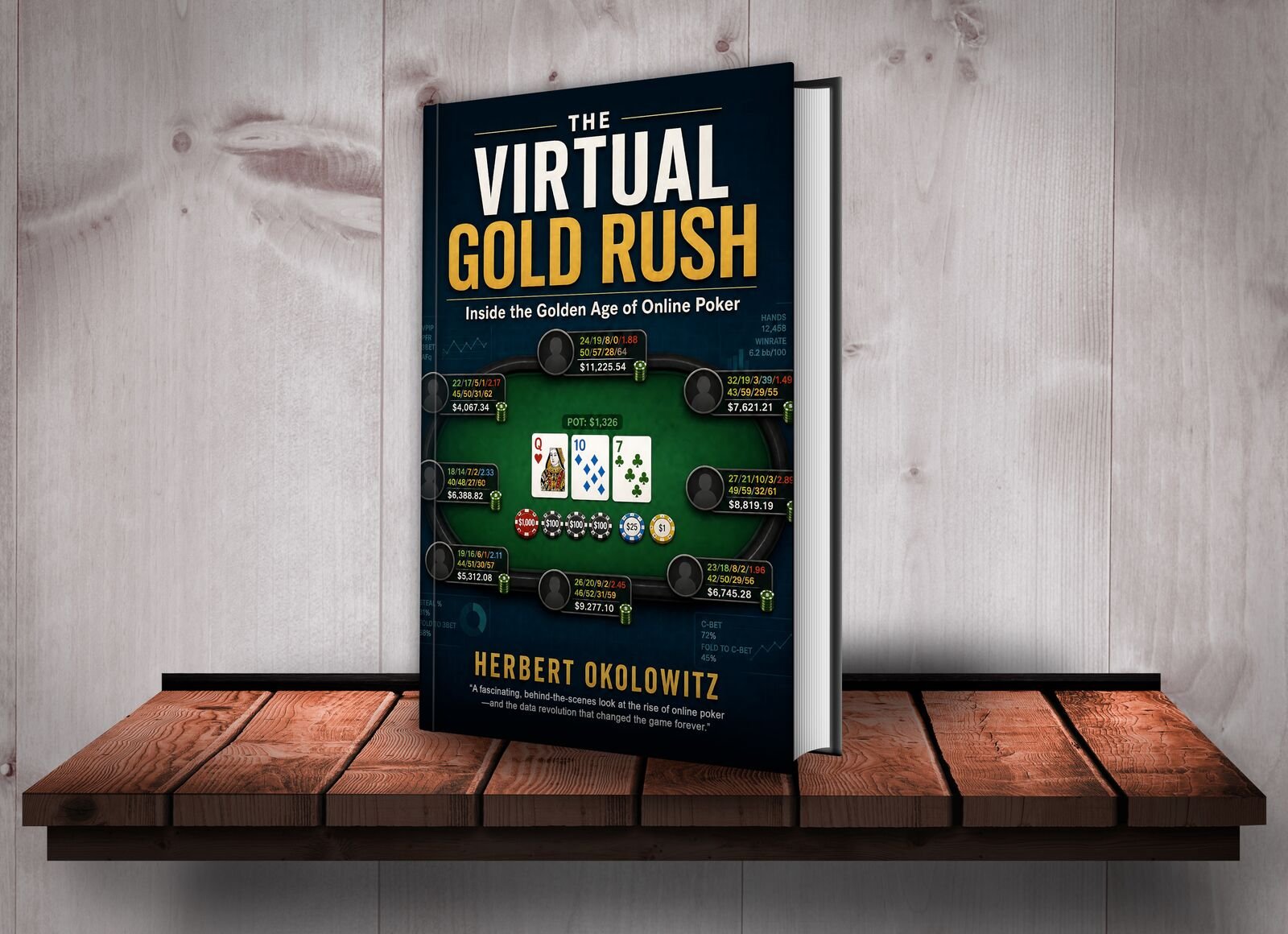
Virtual Gold Rush tells the story of that decade: a handful of servers in Costa Rica that grew into a global industry, and the ordinary players who turned poker into a full-time job along the way. Then, on a single afternoon in April 2011, the U.S. government shut the biggest sites down and the whole thing came apart.

Get Virtual Gold Rush
Buy on Amazon — $24.99 print / $12.99 ebook More formats
eBook live Sept 1 · Paperback Sept 2, 2026
The Online Poker History This Book Covers
The book is organized around five systems that built and ran the online poker ecosystem. Each chapter is self-contained and can be read independently; read sequentially, they present a layered argument for how the Golden Age was constructed, and how it fell apart after April 2011.
- Schools and Study Culture — How CardRunners, PokerStrategy.com, and public forums turned private poker knowledge into a mass-accessible skill, and what happened to competitive edge once theory became free.
- Tools, Analytics, and Automation — PokerTracker, Holdem Manager, and the rise of HUDs: the data-driven arms race that made statistics, not intuition, the currency of the game.
- Platforms — A history of the sites that built and lost the game: PokerStars, Full Tilt, UltimateBet, and the networks and country pools behind them, including what site-level decisions determined who survived Black Friday.
- Economy, Rakeback, and Affiliates — How rakeback functioned as an informal salary for professionals, and how the affiliate economy funded an entire infrastructure of training, staking, and media around the game.
- Tournaments — The Sunday Million, satellite ladders, and how online qualification built a pipeline from a $3 buy-in to a $10,000 WSOP seat.
The book also includes an Introduction, a Coda (“The Golden Age, in Hindsight”), and a Glossary of era-specific terminology.
Why This Online Poker History Matters Now
The historical record of the online poker boom is rapidly disappearing, often faster than participants realize. Key forums are now often inaccessible or lost. Training-site video libraries vanished with site closures and were rarely archived. Internal documents explaining rakeback contracts or country pools are generally not public. Many platform pages from 2007 are gone, and influential screen names are increasingly untraceable or inactive. (See also: how players got into online poker in the early days.)
Each year, writing a comprehensive reference on the Golden Age becomes more difficult. Virtual Gold Rush was written while it was still possible to document that history of online poker thoroughly.
“A fascinating, behind-the-scenes look at the rise of online poker — and the data revolution that changed the game forever.”
About the author
Herbert Okolowitz holds a PhD in Philosophy (Augsburg & Bologna, 2006) and worked as a poker coach and later Head of Education at PokerStrategy.com, one of the largest poker training platforms of the online boom era. He played professionally from 2011 to 2017, specializing in Pot-Limit Omaha, and is co-author of Mastering Pot-Limit Omaha: The Modern Aggressive Approach (D&B Poker, 2014) and author of PLO for Beginners, translated into 16 languages. He now lives in Barcelona.
Get Virtual Gold Rush
Buy on Amazon — $24.99 print / $12.99 ebook More formats
eBook live Sept 1 · Paperback Sept 2, 2026
Online Poker History FAQ
When does Virtual Gold Rush release?
eBook September 1, 2026. Paperback September 2, 2026.
Is this a poker strategy book?
No. It’s narrative nonfiction: a structural history of how the online poker industry was built, ran, and fell apart, not a guide to playing better.
Who is this book for?
Anyone who remembers the online poker boom, played through it, or wants to understand how a specific, disappearing digital economy actually worked, from the schools and tools to the money behind the tables.